


VICTORIAN ERA FASHION PART TWO (1870s-1890s)
We’ve put together another ultimate guide to help you make a historically accurate late Victorian period look for your dolls! Let’s continue our journey through this historical period. To recap, the Victorian era lasted from the 1830s until 1901 (when the Edwardian era began). This article will cover from the 1870s through the 1890s as styles stayed somewhat similar during this time to see part one 1830-1860s Victorian fashion, click here.
The Victorian era was named after the British Queen Victoria, who reigned from 1837 to 1901. The later Victorian period diverges from the early Victorian period through the disappearance of full skirt and full sleeves. Queen Victoria popularized the new thinner style after the death of her beloved husband, Prince Albert, in the 1860s. Victoria’s influence on fashion not only stretched across the Commonwealth but over to the eastern coast of the United States as well.
Bonus Giveaway! Scroll Down to the bottom of the post to Enter to Win a $50 Pixie Faire Gift Card!
1870s

The 1870s took a sharp turn from the 1860s and previous decades when it comes to fashion. Everything began to lose its copiousness and volume. This is in part due to Queen Victoria’s becoming a widow just a few years prior to this period. In fact, dress skirts narrowed down so much that by 1870 the range of foot movement within these skirts could be as little as six inches! However, just because the volume was gone from womenswear that did not mean that there was no decadence about it. Victorian bustles, which first became on-trend in 1870, were made by using special crinoline-like undergarments under a woman’s dress near her bum. Fabric from the skirt was then draped over and pinned onto the undergarment to give it a full-bustled look. The bustle at the back would almost always evolve into a long, dramatic train behind the dress. This was another feature that was newly on trend. Along with the bustles, dresses in the 1870s began to sport cuirass bodices, which were long bodices that were fitted close to the body and extended down past the hipline. Cuirass bodices were stiffly boned to promote pristine posture. They were also inspired by a piece of defensive armor that was worn close-fitted over the torso. This further differentiated the 1870s dress from the fit and flare at the waist that was popular for decades before. Sometimes cuirass bodices would feature sleeves that were different colors or prints than the rest of the dress for decoration.
1880s
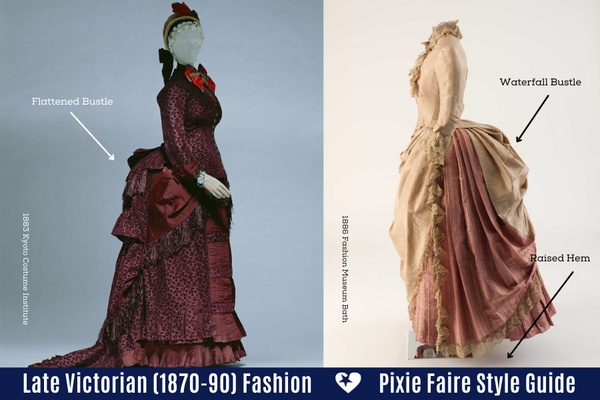
Bustles in the 1880s flattened a bit and introduced a new type of crinoline-type garment that was made of metal framework, to ensure a very ridged bustle. Even though bustles became flatter, this did not mean that they became any less dramatic. More attention was brought to them through a new trend of adding excess draping around the hips and waistlines which culminated in the back. This culmination was then gathered and draped after being pinned in place, resulting in a “waterfall”-style draped bustle. Hems on dresses were also brought up, and, therefore, eliminated the trend of dramatic trains as well. Cuirass bodices were still the most popular choice for a bodice of a dress at this time.
1890s

In the 1890s, the focus of the dress shifted from the skirt to the bodice. Bodices were no longer stiff and ultra-fitted to the body but were lighter and more voluminous. In the early 1890s, Sleeves started to have the most poufiness in the shoulder area since the end of the 1860s. By the end of the 1890s, sleeves had swelled to a massive puffs which remained popular throughout the turn of the century. Waistlines were brought up slightly and were often decorated with lace, sashes, or other embellishments. The addition of yokes onto front bodices for decoration also became in vogue. These often brought the neckline up high with frills extending even above the long neckline. Bolero jackets or bolero-like bodices became popular for dresses. This was a similar trend to the 1850s when jackets became a popular choice for womenswear. Skirts at the beginning of the decade lost their bustles and became more fitted to the waist. This changed very quickly, however. By the end of the decade (and the century), hems dropped to the ground once again and long dramatic trains were back in style.
COLORS AND PRINTS

Popular colors during this period were deep colors like shades of blue, brown, chartreuse, olive, and wine. Other, brighter colors were also popular for certain societal classes and types of clothing. Jewel tones were the most prominent of the bright colors. Yellows and purples were especially popular during the 1890s. The fabrics that were used were made of natural fibers like cotton, wool, or silk. This period also, however, favored some more luxurious types of fabric like velvet and satin for the wealthy. Like the earlier part of the Victorian era, small florals and large plaids were still popular choices in prints. Other prints like polka dots and stripes also grew in popularity during this era. You can take a look below for some of our suggested fabric choices:
Royal Purple Stretch Satin from Mood Fabrics
Garnet Solid Velvet from Mood Fabrics
Matte Satin from Joann Fabrics
Houndstooth Wool Coating from Mood Fabrics
Leaf Icon Crinkle Rayon from Joann Fabrics
Pixie Faire offers a wide variety of late Victorian period-inspired patterns, view them all in the Late Victorian 1870s-1890s Fashions collection.

We’d love to hear from you! Please leave a comment and tell us what you like most about late Victorian era fashion! Perhaps the bustles, the ruffles, or the beautiful details...
We'd love to see your creations too, so if you make one, please tag us on Instagram @PixieFaire
You can also share pictures in the Pixie Faire Inspritation Gallery right here on the website, either use the #pixiefaire when posting on IG, or just click the little + box to upload your picture right here on the website!
Thanks everyone!
For Pixie Faire, Katie
ENTER TO WIN A $50 Pixie Faire Gift Card!
To enter this week's contest, simply click the link below and then enter through the giveaway widget at the bottom of the blog post, there are many things you can do to earn multiple entry points!
Contest Details: You enter through the entry form that is embedded on this page and appears just below this paragraph, if you don't see it, be sure to visit the page from your desktop or an alternate browser such as Google Chrome. It may not appear on all mobile devices. The complete rules and entry details appear on the entry form. This is not a comment contest - in other words, leaving a comment on the bottom of this page is not an official entry method. The only required entry method is to leave a comment under this post and then confirm that you did it in the contest widget. One person will receive the Gift Card. You can enter once, or gain multiple entries by completing the other entry methods and increase your chances of winning. Please review all Terms and Conditions on the giveaway page before entering. While we wish we could run this contest everywhere, for legal reasons it is only open to eligible residents of the U.S. and Canada, not including Rhode Island. This contest is exclusively endorsed by Liberty Jane Clothing and Pixie Faire.
a Rafflecopter giveaway
Commenting below and confirming your entry in the widget above gives you one entry method, the other methods are listed in the widget above, be sure to enter in as many ways as you can to receive the maximum amount of entries to win the gift card!
(This post and giveaway are not endorsed or affiliated with American Girl®, no endorsement implied.)
We’d love to hear from you! Please leave a comment and tell us what you like most about late Victorian era fashion! Perhaps the bustles, the ruffles, or the beautiful details...


241 Comments
The bustle with waterfall layers is what I like most about late Victorian era fashion!
I love the graceful silhouette of the Victorian dresses.
I really like the jackets. But I LOVE the history you have been providing! Not only on the late-Victorian era but also the early and the Regency too!
I am actually making one of these dresses at this time. I love the dresses from this period. I always include a bloomers and underskirt with them. My sisters make a lot of doll clothes to give away at Christmas for toys for tots. We buy 18 and 14 inch dolls and include 4-5 outfits with the dolls. Going on our third year. Love your patterns
Love all those details and the elegance of the dresses