


This week, I wanted to show you how to make bar tacks. These little thread wonders are pretty quick to work up, and they're fabulous for holding two layers of fabric near each other, while still allowing them some room for movement. (You can usually find them holding linings in place, but they also work great to hold down troublesome collar points, or even make thread belt loops!)

For this demo, I'm using heavy duty perle cotton, to make it easier to see -- but in most cases, a normal weight sewing thread will do quite nicely...especially if you wax it first!
First, let's make a heavy-duty bar tack; use it to join thick fabrics together, or when you need a bit more heft.
Start by stitching between the two layers of fabric a couple times, leaving some slack. This distance is the finished length of your bar tack.
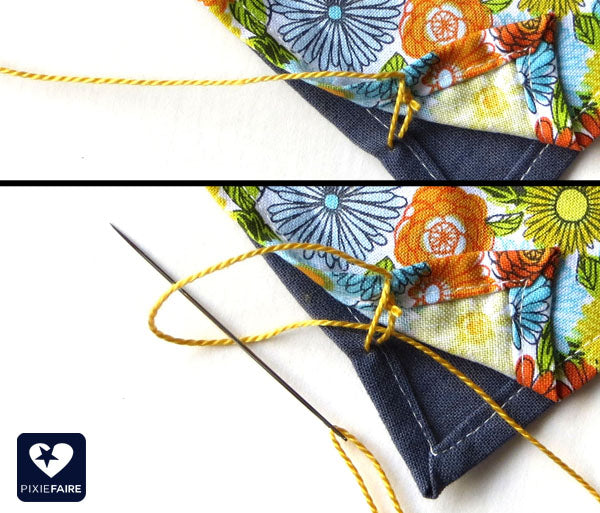
Then, work a buttonhole stitch around the threads -- whip around the thread skeleton, then run your needle back through the loop you just formed.

Keep going until you've covered the entire length of thread with buttonhole stitches. When you reach the end, tie a knot and trim off your thread.
But what about for lighter-weight fabrics, you say? In that case, a thread crochet chain might be just what you need! It's much lighter weight, and also a little quicker to do.
Knot your thread, and stitch a little "x" into one piece of fabric to anchor it. Before you draw the last stitch tight, reach through the loop, and pull another thread loop through.
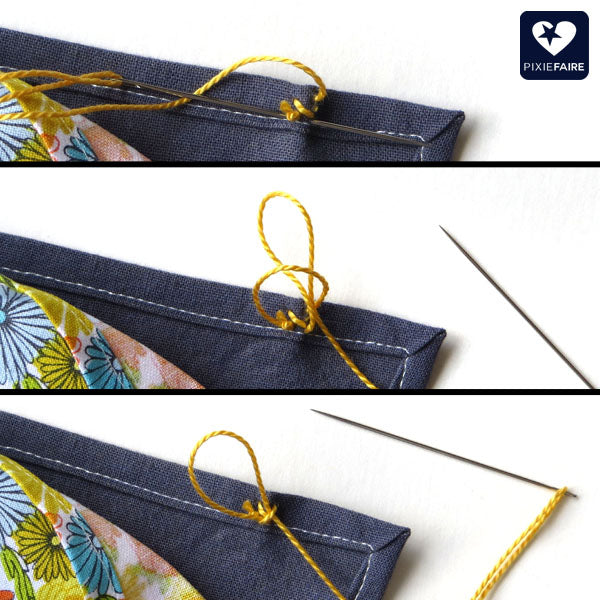
Pull the second loop so that the first loop closes; then, reach through the second loop and make a third...and keep going!

When your crochet chain is as long as you need, run your needle through the final loop and pull it tight; this will finish the chain and keep it from unraveling.
Take a few stitches in the other piece of fabric, and tie off your thread. Congratulations! You've got a bar tack!

Thanks for following along today! How do you use bar tacks? Leave us a comment, and let us know!
For Pixie Faire,
Melinda


16 Comments
Thank you for posting this tutorial. It is extremely helpful!